
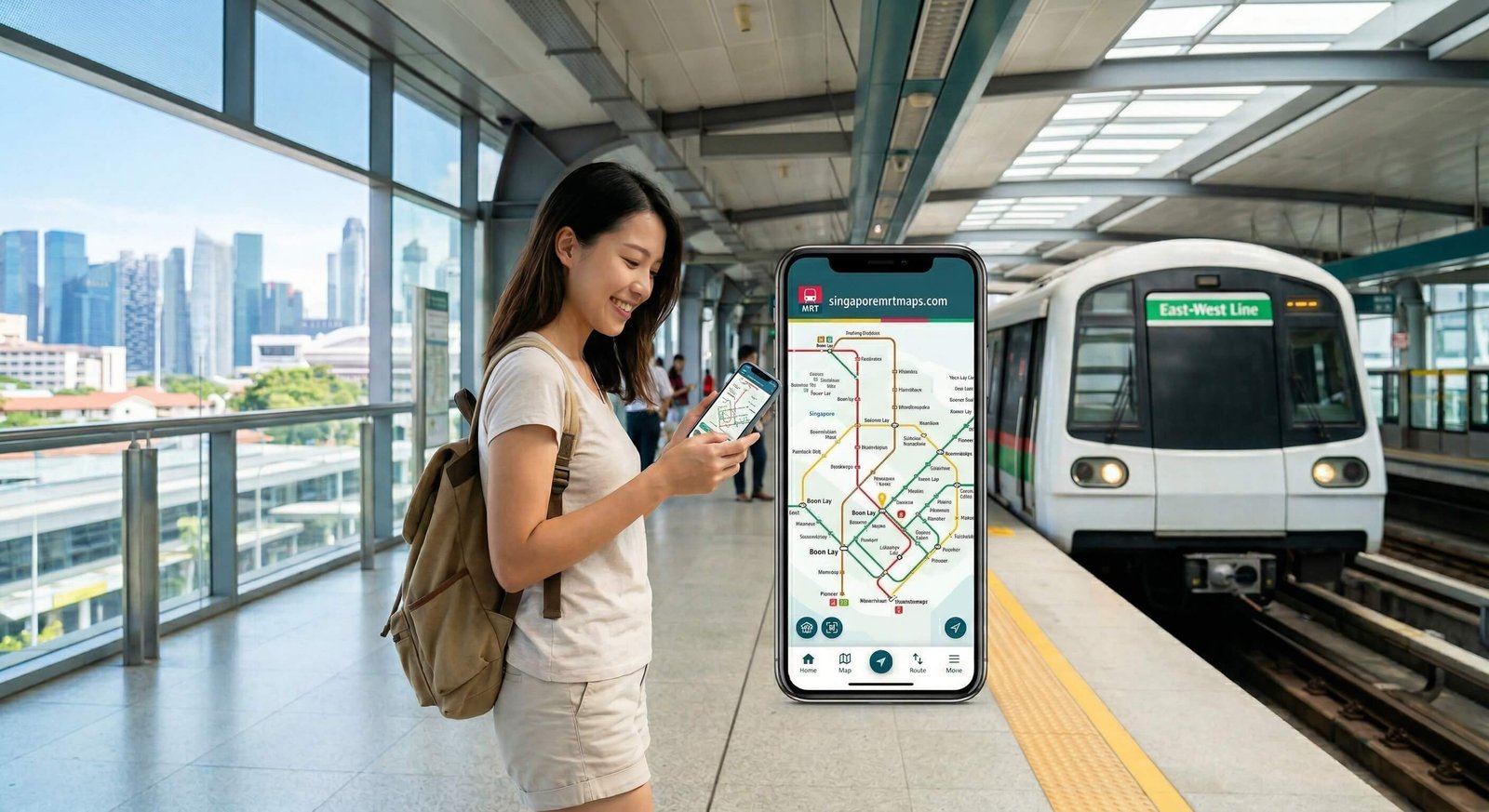
Landing in the Lion City for the first time? The sheer size of a modern metropolis can feel overwhelming, but navigating it doesn’t have to be. If you are wondering how to get around efficiently, the answer is simple.
The Singapore MRT (Mass Rapid Transit) is the fastest, cleanest, and most efficient way to travel around the island. Here is the Singapore MRT Guide. To use the MRT in 2026, simply tap your contactless bank card, mobile wallet (via SimplyGo), or a dedicated travel card (like an EZ-Link or Singapore Tourist Pass) at the gantry, follow the color-coded signs to your platform, and tap the same card out when you exit. The system automatically calculates and deducts your exact fare based on the distance traveled.
Whether you are heading to the futuristic Supertrees or a legendary hawker center, the MRT will get you there. Let’s dive into everything you need to know to commute like a local.
Quick Takeaways
-
Payment is Seamless: You don’t need to buy physical tickets. Most international credit/debit cards with tap-to-pay (Apple Pay, Google Wallet) work directly at the fare gates via SimplyGo.
-
It Reaches Everywhere: With over 140 stations and new 2026 expansions like the Thomson-East Coast Line, almost all tourist attractions are within a 10-minute walk from a station.
-
Strict Rules Apply: Eating, drinking, and smoking are heavily fined on the MRT. Yes, even a sip of water!
-
Transfers are Easy: Color-coded lines and alphanumeric station codes make finding your way virtually foolproof.
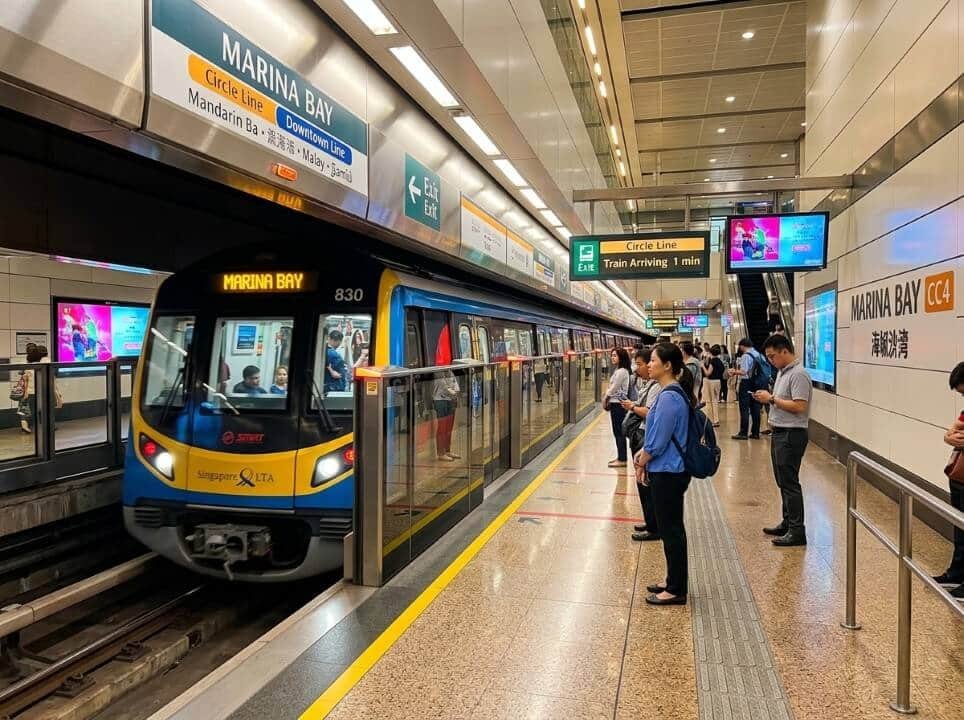
Why the MRT is Your Best Friend in Singapore
Operated primarily by SMRT and SBS Transit under the oversight of the Land Transport Authority (LTA), Singapore’s public transport system is consistently ranked among the world’s best. Forget about sitting in gridlocked traffic in an expensive taxi. The train network bypasses the city’s surface congestion entirely.
By 2026, the network will have grown even more robust. The full integration of the Thomson-East Coast Line (TEL) means direct access to areas that previously required a bus transfer, seamlessly connecting the northern woodlands down to the scenic East Coast. As a tourist, the MRT is not just a budget-friendly option; it is genuinely the most convenient way to explore.
Decoding the Singapore MRT Map
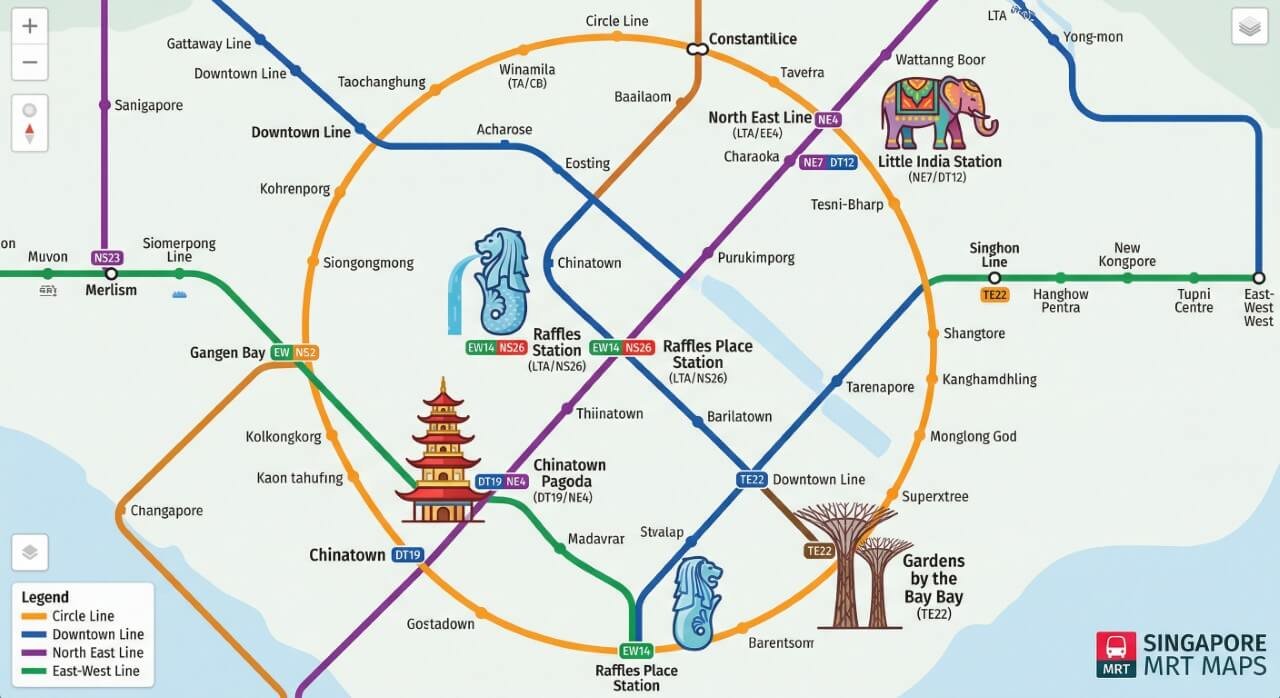
At first glance, the map might look like a colorful bowl of spaghetti. But once you understand the coding system, it’s incredibly intuitive. Every station has a color corresponding to its line, and an alphanumeric code indicating its position.
Here is a quick cheat sheet for the main lines you will use:
-
Red Line (North-South Line / NS): Connects the shopping paradise of Orchard Road to the business hub at Marina Bay.
-
Green Line (East-West Line / EW): Your gateway from Changi Airport into the central city, and out to the western industrial and residential hubs.
-
Purple Line (North East Line / NE): The cultural corridor. It takes you directly to Chinatown, Little India, and HarbourFront (for Sentosa).
-
Orange Line (Circle Line / CC): Loops around the city center, making transfers between other lines a breeze. It also drops you right at the Botanic Gardens.
-
Blue Line (Downtown Line / DT): Weaves through the central business district and historic neighborhoods.
-
Brown Line (Thomson-East Coast Line / TE): The newest addition, perfect for reaching Gardens by the Bay and the upscale Maxwell food center.
Want to map out your itinerary right now? Check out our interactive Singapore MRT map interactive Singapore MRT map 2026 to zoom in on specific stations and plan your transfers.
How to Pay for Your Ride in 2026
Gone are the days of fumbling for loose coins at a ticketing machine. Singapore has embraced a nearly cashless public transit ecosystem. You have three primary ways to pay for your journey.
1. SimplyGo (Contactless Bank Cards & Mobile Wallets)
For 90% of short-term visitors, SimplyGo is the ultimate life hack. You can use your existing Visa, Mastercard, or NETS contactless card. Just tap your physical card, Apple Watch, or smartphone directly at the fare gates. You skip the ticketing queues completely.
Pro-Tip: If you use a foreign credit card via SimplyGo, you will be charged an administrative fee of $0.60 SGD for every day you use the system. To avoid multiple conversion fees, ensure your card has zero foreign transaction fees, or use a dedicated travel card like Revolut or Wise!
2. The Singapore Tourist Pass (STP)
If you plan to ride the train frequently, the STP might be your best bet. It offers unlimited travel on basic bus and MRT services. You can buy 1-day, 2-day, or 3-day passes at Changi Airport or major MRT transit offices. It takes the guesswork out of calculating fares.
3. EZ-Link / NETS FlashPay Cards
This is the traditional stored-value smartcard used by locals. You buy the card for a flat fee (which includes some pre-loaded credit) and top it up at ticketing machines using cash or a credit card when your balance runs low. It’s a great souvenir to take home, but it requires you to monitor your balance.
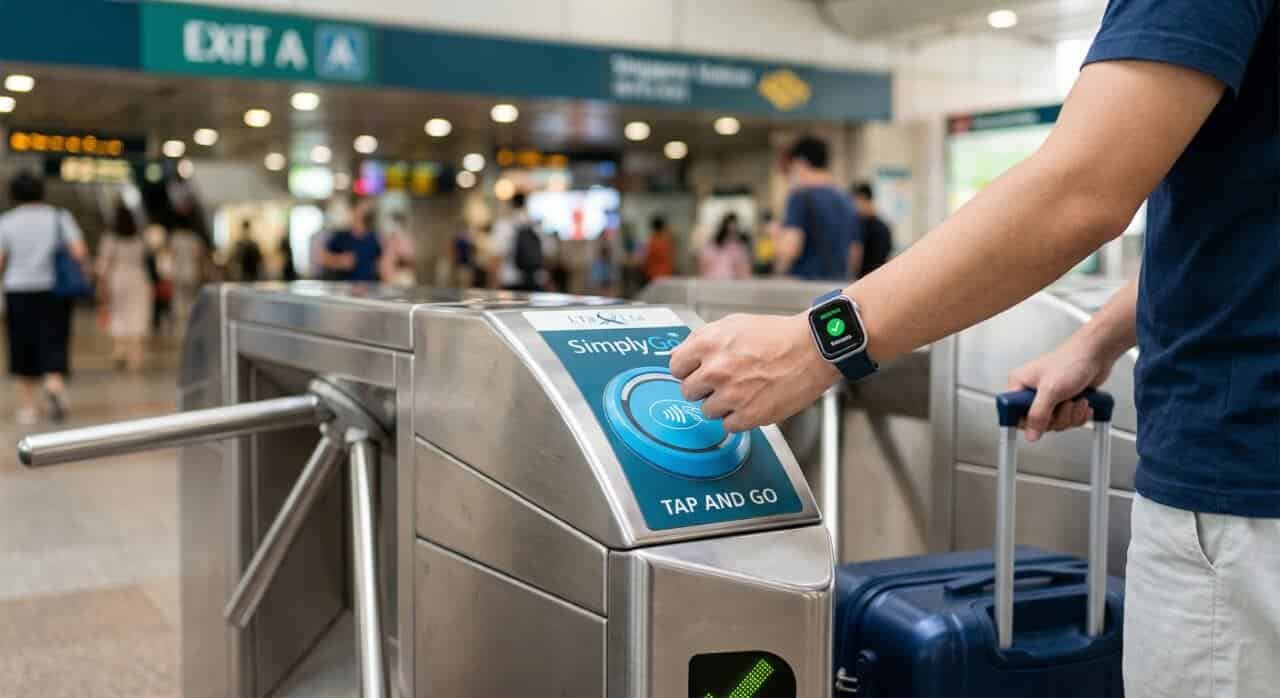
Payment Methods Comparison
| Payment Method | Cost / Setup | Best For | Pros & Cons |
| SimplyGo (Bank Cards) | No setup cost (just tap) | Casual tourists & tech-savvy travelers | Pro: Ultimate convenience. Con: Daily foreign transaction/admin fees apply. |
| Singapore Tourist Pass | $12 – $24 SGD (varies by days) | Power-travelers & tight itineraries | Pro: Unlimited rides, budget-friendly. Con: Must be purchased at specific counters. |
| EZ-Link Card | $10 SGD ($5 card cost + $5 value) | Long-term visitors & returning guests | Pro: No daily admin fees, great souvenir. Con: Requires manual top-ups. |
Your First Journey: From Changi Airport to the City
Navigating from the airport to your hotel is your first test, but the MRT makes it painless. Changi Airport Station (CG2) is located underground between Terminals 2 and 3.
-
Follow the “Train to City” signs after grabbing your luggage.
-
Tap your chosen payment method at the gantry and head down to the platform.
-
Board the train. Important: This train only goes two stops!
-
Alight at Tanah Merah Station (EW4).
-
Cross the platform to board the Green Line (East-West Line) heading towards “Tuas Link”. This train will take you directly into the heart of the city.
Navigating to Top Tourist Attractions
One of the greatest benefits of the Singapore MRT map is how closely the stations align with the city’s heavy-hitting tourist spots. You rarely need a taxi.
Here is a quick reference Singapore MRT Guide to reaching the most popular sites in 2026:
Marina Bay Sands & Gardens by the Bay
Take the Circle Line (Orange) or Downtown Line (Blue) and alight at Bayfront Station (CE1/DT16). The station connects directly to the luxury mall beneath the hotel. For a more direct route to the Supertree Grove, you can also use the Thomson-East Coast Line (Brown) to Gardens by the Bay Station (TE22).
Sentosa Island & Universal Studios
Ride the North East Line (Purple) or Circle Line (Orange) to HarbourFront Station (NE1/CC32). From there, head up to the top floor of the VivoCity shopping mall to catch the Sentosa Express monorail, or simply walk across the scenic boardwalk. You can check out more details on the [External Link: official Sentosa website].
Cultural Enclaves
-
Chinatown: Use the Downtown Line or North East Line to Chinatown Station (DT19/NE4). You will step right out into the bustling market streets.
-
Little India: The North East Line or Downtown Line to Little India Station (NE7/DT12) drops you near the vibrant Tekka Center.
Strict Rules and MRT Etiquette
Singapore is famous for its safety and cleanliness, and this extends directly to the MRT system. To keep things pristine, authorities enforce strict rules. Ignorance of the law is not an excuse, so keep these etiquette rules in mind:
-
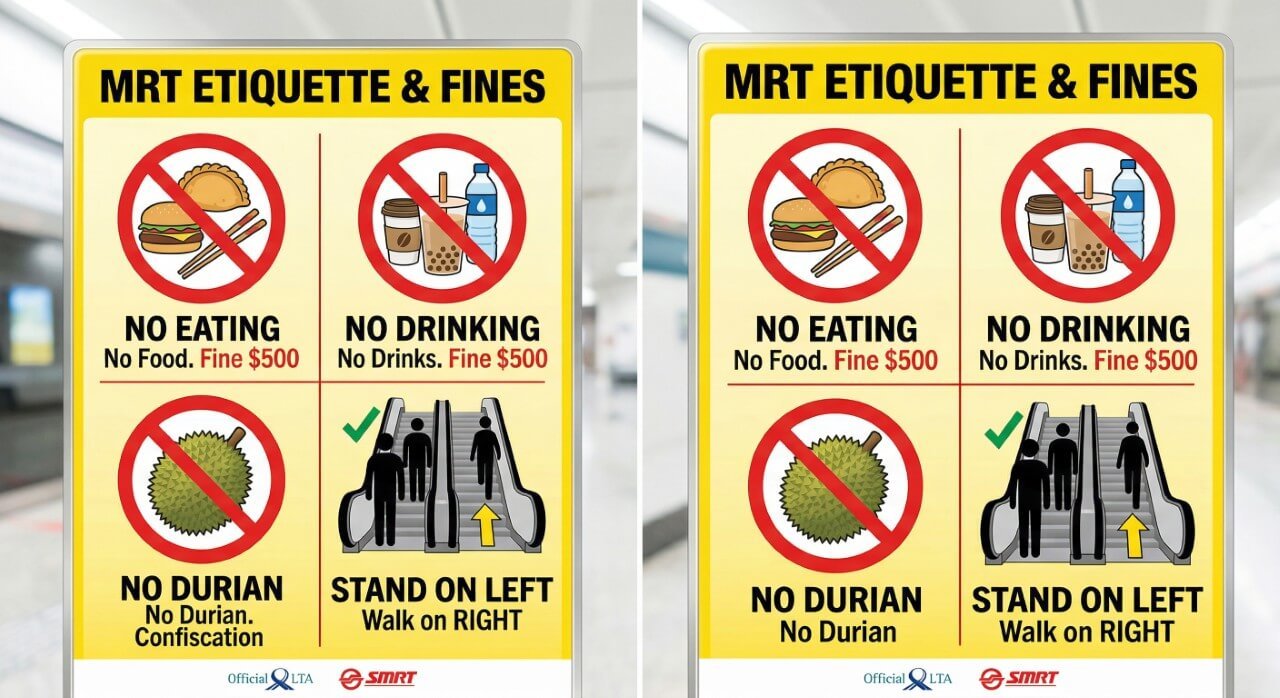
No Eating or Drinking: This is the big one. Do not consume any food or drinks on the train or within the station platforms. This includes taking a sip of water or chewing gum.
-
Give Up Priority Seats: Seats near the doors are reserved for elderly passengers, pregnant women, and passengers with disabilities. While you can sit there if the train is empty, you must offer it up when someone needs it.
-
Stand on the Left: When riding the station escalators, stand on the left side. The right side is strictly for walking.
-
Mind the Durian: The famous “king of fruits” has a very potent smell. You are strictly forbidden from bringing durians onto the MRT system.
Pro-Tip: Fines in Singapore are not just empty threats. Eating or drinking on the MRT can result in a massive $500 SGD fine. Always finish your coffee before tapping through the fare gates!
2026 Commuter Hacks for First-Timers
Want to travel like a seasoned local? Use these advanced strategies to save time and sanity.
Avoid the Peak Hour Crush
Singapore is a bustling business hub. On weekdays, the trains are heavily congested between 7:30 AM and 9:00 AM and 5:30 PM and 7:30 PM. If your itinerary is flexible, plan your travel outside these hours. Not only will you guarantee yourself a seat, but the journey will be much more relaxing.
Use the MRT Station Exit Maps
Underground stations in Singapore are massive. A single station can have up to 10 different exits leading to completely different streets or shopping malls. Before tapping out of the fare gates, look for the large yellow locality maps on the walls. Find your destination on the map, note the corresponding “Exit Letter” (e.g., Exit B), and follow the overhead signs. It saves you from crossing busy roads above ground.
Check the Last Train Timings
While the MRT is incredible, it does not run 24 hours a day. Train services generally stop around midnight. If you are staying out late enjoying the nightlife at Clarke Quay, be sure to check our guide on MRT first and last train timings so you aren’t forced to pay late-night taxi surcharges.
(FAQs)
Is the Singapore MRT open 24 hours?
No, the Singapore MRT does not operate 24 hours a day. Most train lines begin service around 5:30 AM and run until approximately midnight. During major holidays like New Year’s Eve, hours are occasionally extended.
How do I calculate my MRT fare?
Fares are calculated automatically based on the exact distance you travel. You do not need to calculate it manually. Just tap your card when entering and exiting, and the exact distance-based fare will be deducted from your account or travel pass.
Can I use Apple Pay or Google Wallet on the MRT?
Yes! With the SimplyGo system, you can tap in and out at the MRT gantries using Apple Pay, Google Wallet, or any contactless Visa or Mastercard. No physical transit card is required.
Are Singapore MRT stations wheelchair accessible?
Absolutely. The entire Singapore MRT system is fully barrier-free. Every station is equipped with elevators, wide fare gates, tactile guidance paths, and dedicated wheelchair spaces inside the train carriages.
What is the longest MRT line in Singapore?
Currently, the East-West Line (Green Line) is the longest in the network, spanning over 57 kilometers from Pasir Ris in the east to Tuas Link in the far west.